Pharmaceuticals and laboratories
Fans in pharmaceutical processes: selection and integration
Fans used for pharmaceutical process extraction must deliver the required airflow and pressure without compromising hygiene, maintenance or noise control. Industrial applications must be distinguished from air-conditioning systems for clean areas.
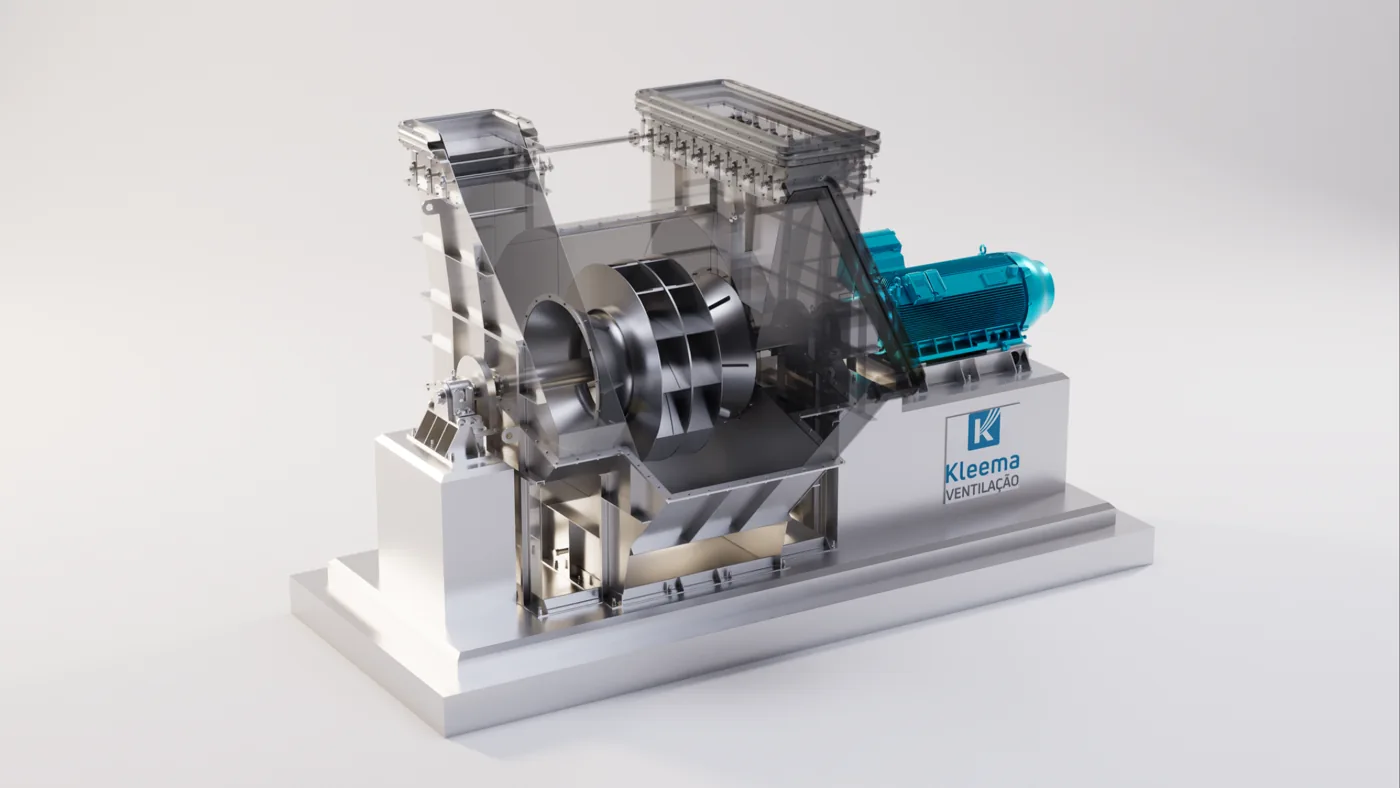
The process and emission sources
Pharmaceutical fans may serve machine extraction, dust collection, booths or treatment circuits. Each function has its own pressure range and hygiene requirements. The fan in a dust collector should not be treated as equivalent to one in an air-conditioning system that controls room air quality.
The position relative to the filters defines the expected exposure of the impeller. Even on a side considered clean, maintenance conditions and element failure must be anticipated. Characterization must indicate whether moisture, cleaning agents, vapors or product capable of forming deposits are present.
Characteristics that guide engineering
Stream composition determines materials and sealing. The presence of solvents or highly potent powders adds specific requirements that must be defined by the process and risk assessment.
Solution configuration and sizing
Aerodynamic selection must consider circuit resistance with new elements and under working conditions, as well as operating variations. Selecting solely for the point of lowest pressure drop can leave the system without capacity as the filter loads. Uncontrolled oversizing, in turn, can increase noise and interfere with the process.
Materials and finish must be defined by actual contact with the stream and hygienic cleaning procedures. Access to the impeller, seal configuration and the ability to dismantle the unit influence use. Where containment is required, maintenance of the fan and its connections must also be included in the strategy, without assuming protection merely because an upstream filter is present.
Design parameters
| Parameter | How to assess it | Engineering decision |
|---|---|---|
| Circuit function | Identify extraction, collection or air conditioning | Define the correct scope |
| Filter resistance | Assess different loading conditions | Preserve the required airflow |
| Cleaning and access | Check materials and dismantling | Adapt maintenance to the process |
- Select the operating point using actual losses.
- Account for loaded filter conditions.
- Provide maintenance and cleaning.
- Check vibration and noise after installation.
Performance, diagnostics and maintenance
During commissioning, airflow, pressure, speed and power must be verified under circuit conditions. Vibration and noise must be related to duct arrangement, foundation and inlet and outlet conditions, rather than impeller balancing alone.
Stable operation depends on maintaining the conditions for which the assembly was selected. A product change, a new filter element or a branch modification may change resistance. Recording these changes makes it possible to assess whether increased consumption stems from fan condition or a new system demand.
Noise and stability
High noise levels must be investigated in terms of aerodynamics, transmission and installation, rather than being addressed solely through acoustic insulation. Matching the fan to the system curve helps avoid operation outside the intended range.
Further technical reading
Does your process need an assessment?
Talk to Kleema engineering about sizing, modernization and operating conditions.
Talk to engineering ↗