
Discharge and handling
Double-flap valves
Discharge of highly abrasive materials or materials with a high risk of jamming in rotary airlocks.
Request an application assessment ↗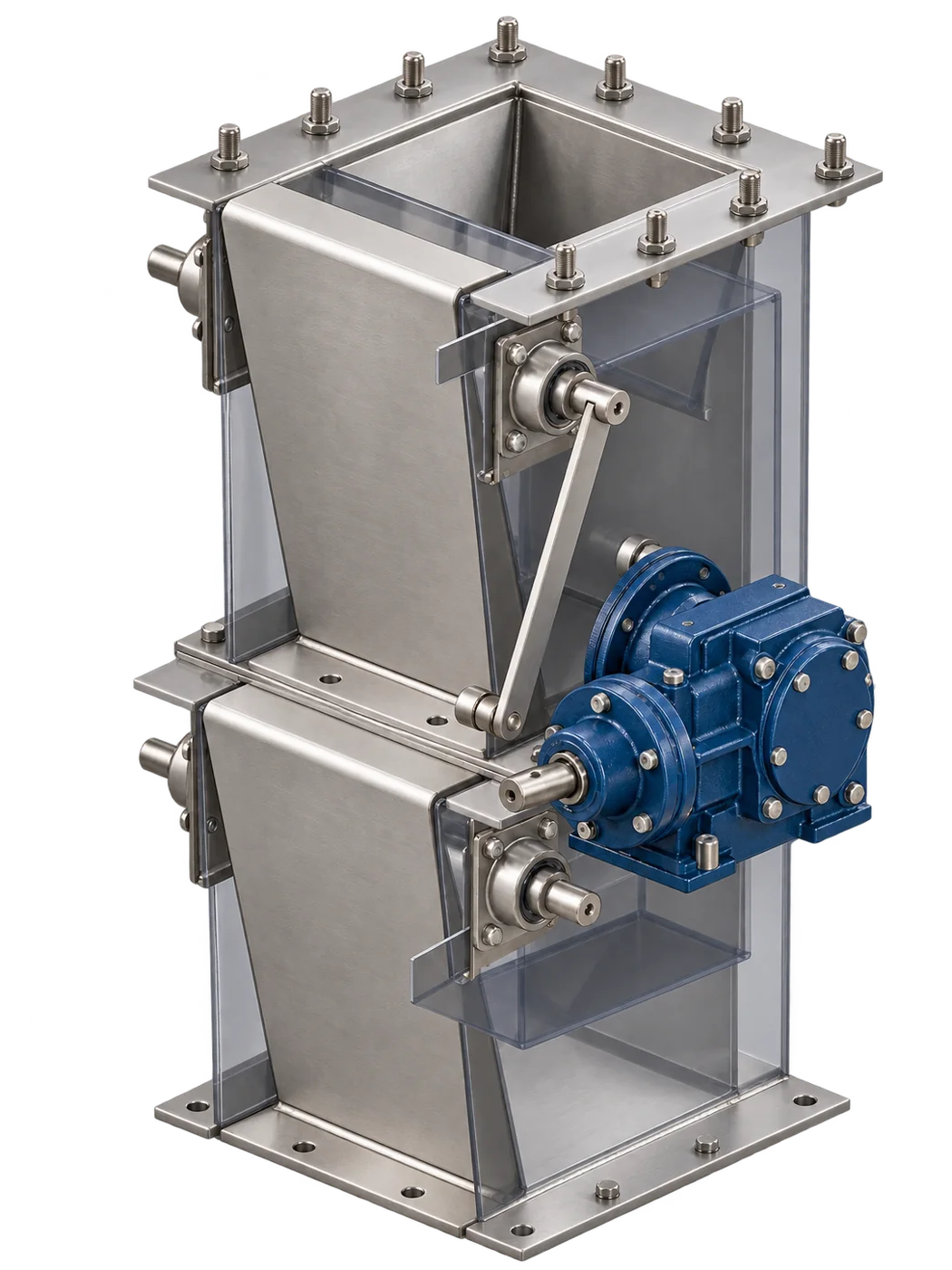
Wear resistance and sealing
Discharge of abrasive materials with a high risk of jamming
Kleema double-flap valves are particularly suited to discharge of highly abrasive materials or materials with characteristics that increase the risk of rotary airlock jamming.
Alternating operation of the two flaps allows material to pass while limiting direct communication between inlet and outlet. This configuration offers an alternative where wear and difficult particulate movement compromise rotary airlock discharge reliability.
Selection of materials, sealing surfaces, and actuation considers particle size distribution, abrasiveness, temperature, differential pressure, and operating duty, aiming for durability, sealing, and process continuity.
Double-flap valves with counterweights and drive guards
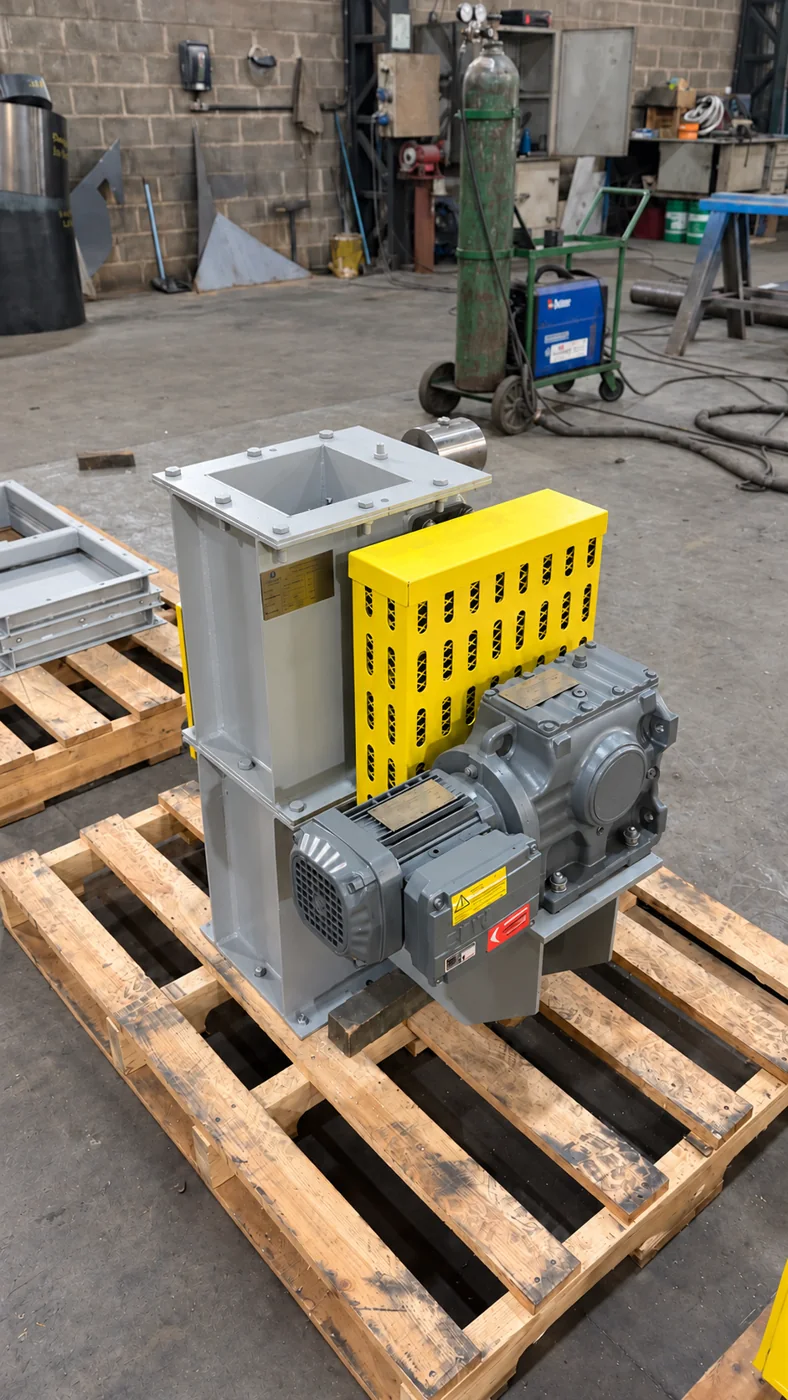
Engineering for wear resistance and reliable discharge
Design considers abrasiveness and material passage characteristics, along with coordinated flap operation and preservation of sealing surfaces throughout use.
- Material passageOpening and flap geometry assessed for particle size distribution and particulate behavior, with attention to conditions that promote blockages and jamming.
- Wear resistanceConstruction materials and surfaces in contact with particulate selected for abrasiveness, temperature, and operating duty.
- Cycle and sealingAlternating opening and closing to allow discharge while keeping one flap closed throughout the sequence; seating surfaces defined for the application.
- Actuation and mechanismsActuation, linkage, and counterweight configuration, where applicable, suited to the discharge cycle and operating conditions.
- Inspection and maintenanceAccess considered for inspecting flaps, wear surfaces, seals, and mechanisms, and facilitating necessary interventions.
Materials and coatings in product contact areas are selected for the wear mechanism. Manufacturing includes dimensional, assembly, and functional inspections of flaps and mechanisms according to equipment configuration.
Applications and industries
Kleema double-flap valves discharge filters, cyclones, silos, and hoppers handling highly abrasive materials or materials with a high risk of jamming in rotary airlocks.
They offer an alternative for discharge points where particulate characteristics require special attention to wear resistance, material passage, and system sealing.
Application industries include:
Valve suitability is assessed according to particle size distribution, flow behavior, abrasiveness, temperature, and differential pressure, along with required discharge capacity and cycle.
Technical information
Double-flap valve specification considers material characteristics, wear resistance, and coordinated flap operation to meet discharge and sealing requirements.
| Discharge capacity | Material flow rate, bulk density, volume per cycle, and discharge frequency. |
|---|---|
| Particle size distribution and flow | Particle size, shape, and characteristics that may promote blockage or jamming. |
| Abrasiveness and wear | Wear conditions for selection of materials and surfaces in contact with particulate. |
| Temperature and pressure | Operating temperature and inlet-to-outlet differential pressure. |
| Flaps and sealing | Opening geometry, seating surfaces, and closure conditions. |
| Actuation and cycle | Mechanism configuration and opening and closing sequence of the two flaps. |
| Installation and maintenance | Connections, available space, and access for component inspection and service. |
Double-flap valves
Does your material require a more robust discharge solution?
Provide particulate characteristics, discharge capacity, and operating conditions. Kleema engineers can assess double-flap valve suitability, considering abrasiveness, jamming risk, and process sealing requirements.