Pharmaceuticals and laboratories
Powder containment for HPAPIs: integrating process and filtration
Highly potent active pharmaceutical ingredients require a containment strategy defined by occupational exposure assessment and the pharmaceutical process. Choosing a dust collector in isolation does not demonstrate that the required containment has been achieved.
The process and emission sources
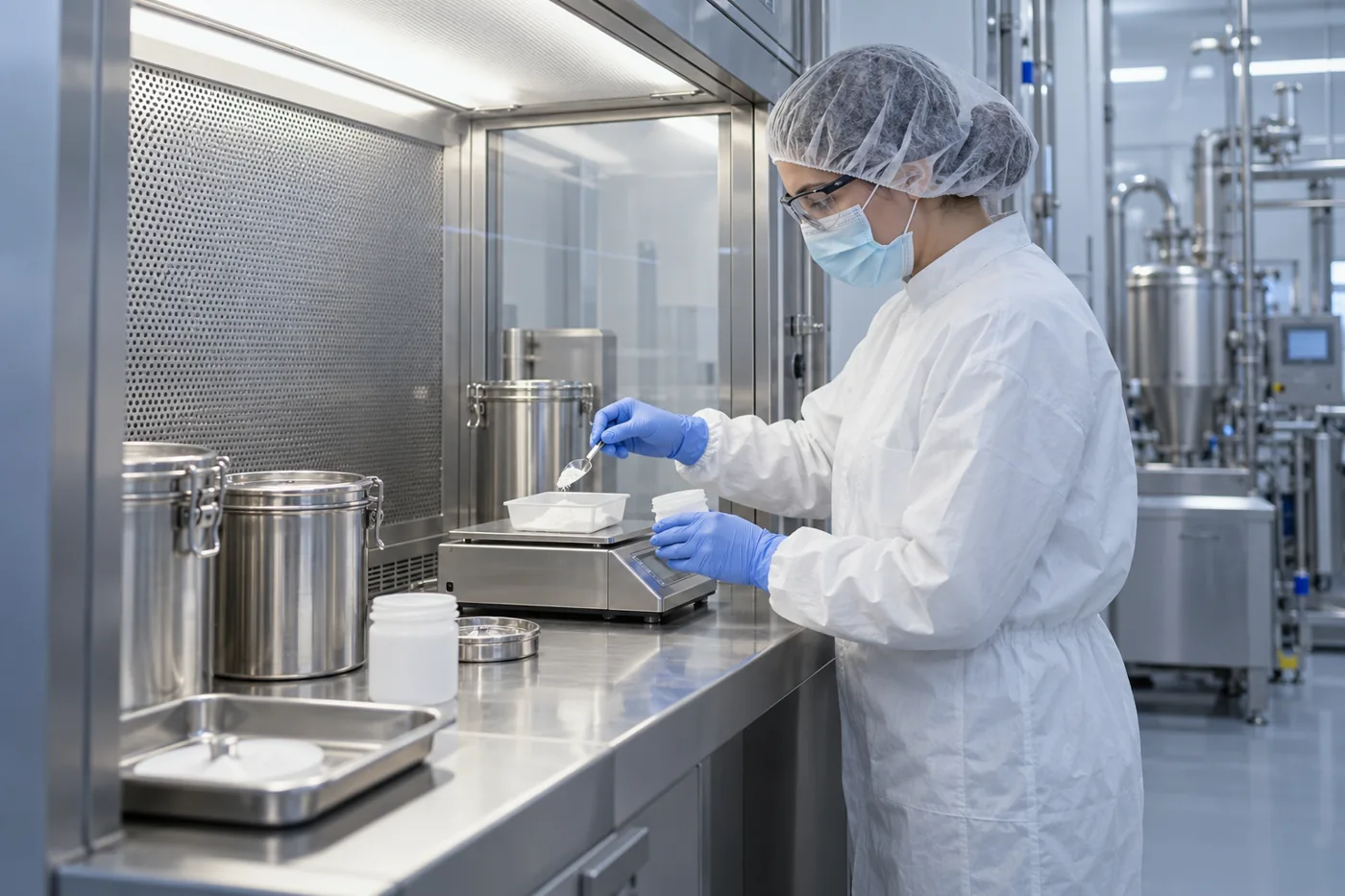
HPAPIs are highly potent active pharmaceutical ingredients for which small quantities may have toxicological significance. Weighing, container connection, mixer feeding and filter element replacement present different exposure scenarios. The design must consider every task, including interventions outside normal production.
Containment must begin with an assessment of the product and the exposure limit defined by competent professionals. Containment classes or bands cannot be selected solely on the basis of extraction airflow. Primary barriers, procedures and demonstrated performance are essential to relate the solution to the actual risk.
Characteristics that guide engineering
Capture, physical barriers, relative pressures, maintenance and disposal must function as a whole. The need for final filtration, contained changeout and performance testing must be specified according to the product and validated by the facility.
Solution configuration and sizing
Depending on the operation, the architecture may combine isolators, contained connections, booths and dedicated extraction. A dust collector acts within one part of this architecture and does not replace the necessary barrier at the product. Relative pressures and airflow paths must prevent contaminant transfer to unintended rooms or equipment.
Selection of filtration stages must address retention, integrity, decontamination and maintenance. Where high-efficiency final filters and contained changeout systems are required, their interfaces must be specified and qualified. Differential pressure readings are useful for monitoring resistance, but do not establish the absence of leaks or containment efficiency.
Design parameters
| Parameter | How to assess it | Engineering decision |
|---|---|---|
| Potency and exposure limit | Assess the product and tasks | Define the required containment |
| Changeout and disposal | Analyze collector interventions | Prevent dispersion during maintenance |
| Integrity and exposure | Use separate checks | Demonstrate overall system performance |
- Understand exposure limits and handling operations.
- Assess cleaning and cross-contamination.
- Define element changeout and disposal.
- Verify containment through appropriate testing. Differential pressure alone does not demonstrate filter integrity.
Performance, diagnostics and maintenance
Performance must be demonstrated during representative tasks, including opening, connection, cleaning and waste removal. Surrogate-material testing and occupational assessment may be necessary under a protocol defined for the process. Qualification must distinguish element integrity from the containment effectiveness of the complete system.
There must also be criteria for responding to failures and returning to operation after maintenance. The choice of bags or cartridges alone does not ensure compliance with good practices or exposure requirements. Kleema's contribution must be limited to the defined engineering and supply scope, integrated into the facility's pharmaceutical strategy.
Containment verification
The level of protection must be demonstrated through qualification procedures and tests appropriate to the task. Element changeout, cleaning and waste removal are also critical operations and must form part of the assessment alongside normal production conditions.
Further technical reading
Does your process need an assessment?
Talk to Kleema engineering about sizing, modernization and operating conditions.
Talk to engineering ↗