Agribusiness and fertilizers
Combustible dusts in agribusiness: filters and rotary valves
Dusts from grains, meals and other organic materials can form combustible atmospheres. Filters, ducts and discharges must be assessed together to reduce the possibility of ignition and limit event propagation.
The process and emission sources
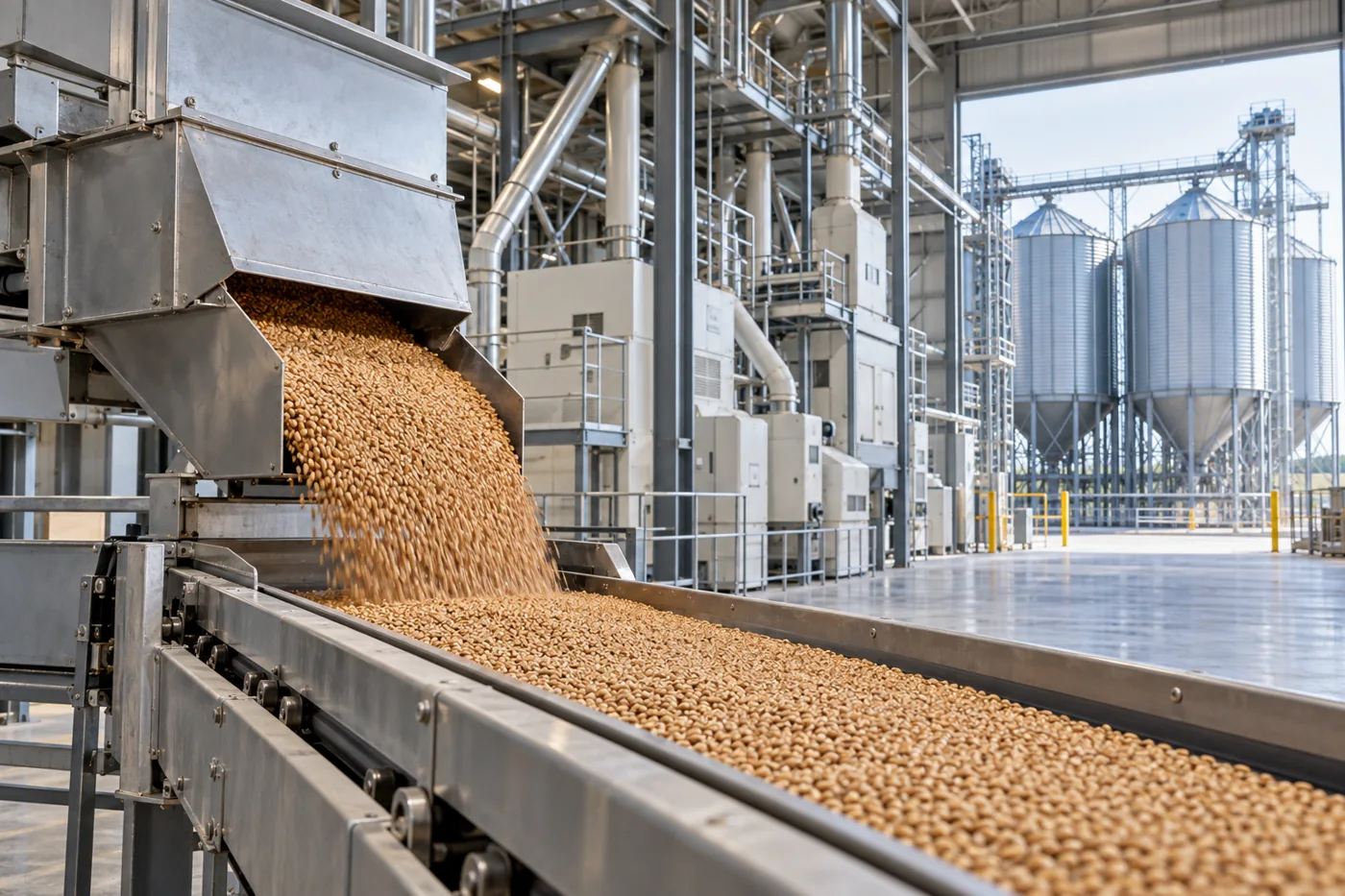
Dust from grains, meals and organic materials can become combustible when dispersed under conditions suitable for ignition. Collection concentrates this material in filters and discharges, while ducts connect distinct sources. Analysis must consider where dust concentrates, how it circulates and which events may introduce ignition.
Material properties depend on composition, particle size and moisture and may change between campaigns. It is insufficient to classify the entire agroindustrial sector as a single scenario. Characterization and risk analysis must guide the measures required for the actual installation.
Characteristics that guide engineering
A conventional discharge rotary valve should not be presumed to be an explosion barrier. That function requires specific design and demonstrated performance for the material and conditions of use. Spark arrestors also do not eliminate all ignition mechanisms.
Solution configuration and sizing
The design must combine prevention of ignition sources, deposit control and protection according to the scenario. Selecting venting, suppression and isolation requires matching equipment and propagation paths. Prevention and mitigation have different functions; one measure should not be presented as an automatic substitute for the others.
An ordinary rotary valve is discharge equipment. To provide explosion isolation, it must have a design, application and demonstrated performance compatible with that function. Geometry, clearances, wear and material conditions matter. Likewise, bags with dissipative properties or spark-retention devices do not make the entire system explosion-proof.
Design parameters
| Parameter | How to assess it | Engineering decision |
|---|---|---|
| Dust and process | Characterize actual conditions | Define prevention and protection |
| Valve function | Distinguish discharge from isolation | Require suitability for the function |
| Wear and modifications | Check clearances and configuration | Preserve specified performance |
- Characterize the dust.
- Assess grounding and hot sources.
- Define protection and isolation where needed.
- Maintain clearances and components according to specification. Operation and maintenance form part of the protection strategy.
Performance, diagnostics and maintenance
Maintenance must preserve the specified characteristics of protection components. Replacements, changes in speed, connection modifications and repairs may affect intended performance. Inspection must distinguish normal discharge conditions from those required for a demonstrated protective function.
Monitoring must also consider dust leakage, deposits and product changes. A filter may collect well yet have inadequate protection; the two objectives must be checked separately. The engineering solution must state clear limits and conditions of use rather than promise universal elimination of risk.
Inspection of discharge and isolation
Wear and changes in clearance can compromise the intended functions of protective equipment. Inspections must follow the applicable specification, without adapting a conventional valve to an unproven isolation function.
Further technical reading
Does your process need an assessment?
Talk to Kleema engineering about sizing, modernization and operating conditions.
Talk to engineering ↗