Agribusiness and fertilizers
Dust control in fertilizer granulation and blending
Fertilizer mixers, granulators and transfer points can release fines, reduce product utilization and contaminate adjacent areas. Dust extraction begins with identifying sources and characterizing each formulation.
The process and emission sources
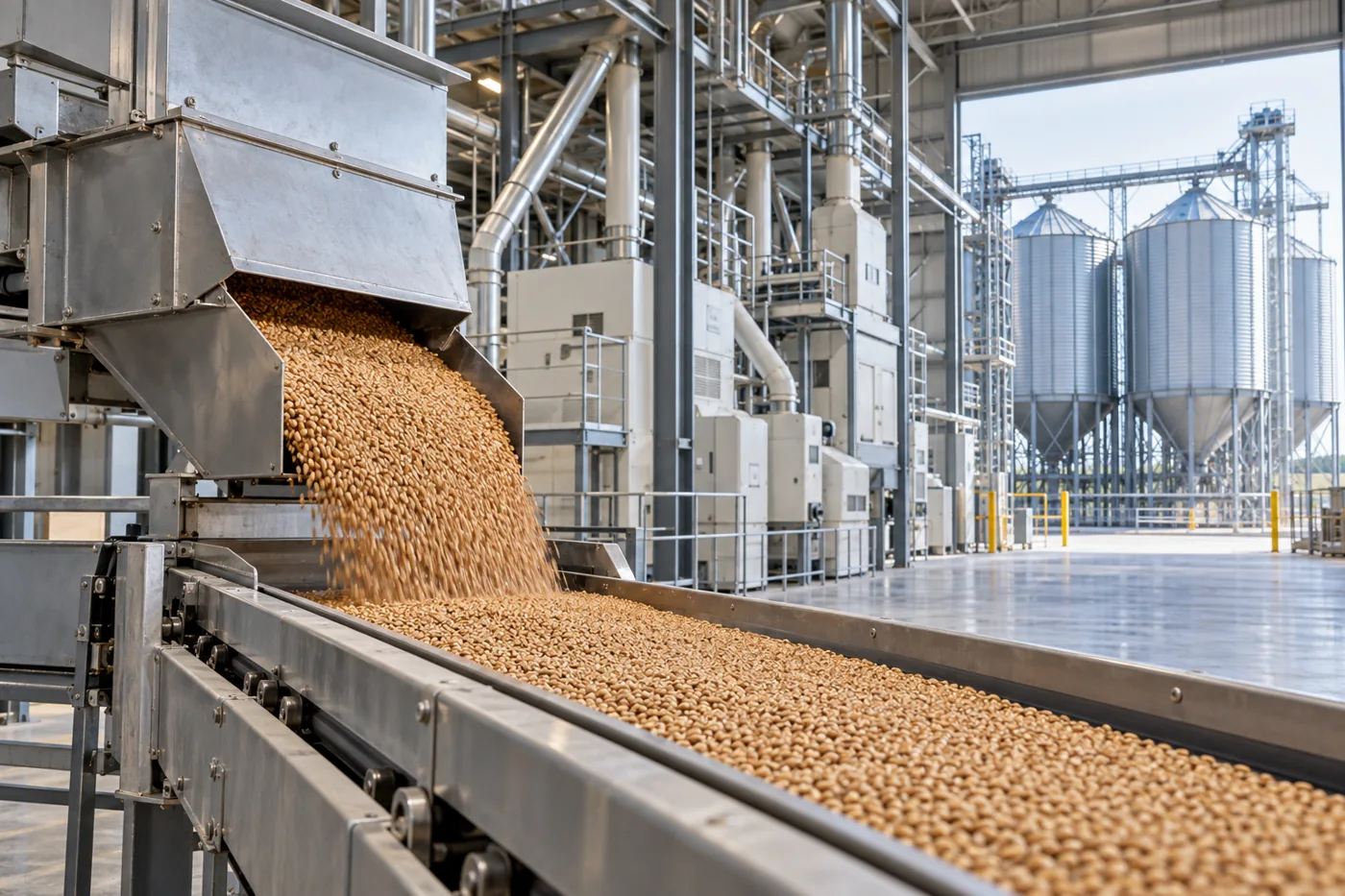
In fertilizer production, mixers, granulators and dryers produce emissions through different mechanisms. Blending and transfer release fines through agitation and falling material; granulation can combine moisture, heat and adhesive particles; drying adds a gas stream with its own conditions. The solution must accommodate these differences, even when the equipment belongs to the same line.
Formulation also matters. Particle size distribution, hygroscopicity and the presence of salts change the tendency for deposits to form and the compatibility of materials. Collected dust may have a different composition from the granulated fraction and should not automatically be returned to production.
Characteristics that guide engineering
Hygroscopicity, adhesion and chemical compatibility influence design as much as dust loading. Urea, phosphates and potassium salts should not be treated as a single material with uniform behavior.
Solution configuration and sizing
The first measure is to contain emissions close to their origin, using enclosures that allow operational access and hoods that do not entrain the saleable fraction. Ducts must avoid routes that encourage deposition and provide inspection access where changes of direction and velocity make accumulation likely.
In filtration, fibers and surface finishes must be selected for the chemical condition and moisture of the dust. Greater mechanical strength does not solve the problem of material becoming sticky on the fabric. Pulse cleaning and solids removal must operate in coordination. For casings, fans and seals, the choice between alloys and coatings depends on actual exposure, rather than merely the term fertilizer.
Design parameters
| Parameter | How to assess it | Engineering decision |
|---|---|---|
| Formulation and hygroscopicity | Assess each product | Select materials and cleaning strategy |
| Recovered dust | Check composition and quality | Define return, segregation or disposal |
| Differential pressure | Compare by production regime | Detect adhesion and loss of capacity |
- Prioritize enclosure and capture close to the source.
- Select coatings and filter media according to the product.
- Prevent condensation.
- Assess whether collected dust can return to the process without compromising composition.
Performance, diagnostics and maintenance
Assessment must combine capture efficiency, differential pressure stability and the mass of recovered fines, always relating the results to formulation and production rate. A reduction in collection may indicate lower emissions at the source, but also an aspiration failure: the indicators must be interpreted together.
Damp areas in the hopper, crusts and increased compressed-air consumption are signs that process conditions may have changed. The economic analysis must separate the value of recoverable material, residue disposal costs and the reduction in interventions. It is incorrect to count all collected dust as recovered saleable product.
Product recovery and stability
The return of fines must be determined by fertilizer quality and the potential for mixing between batches. Continuous discharge and the prevention of accumulation help keep the filter available, but economic recovery must be calculated using losses that have actually been measured.
Further technical reading
Does your process need an assessment?
Talk to Kleema engineering about sizing, modernization and operating conditions.
Talk to engineering ↗