Agribusiness and fertilizers
Dust extraction in fertilizer handling and dispatch
Fertilizer transfer, loading and bagging generate localized emissions that vary with drop height, product flow rate and enclosure conditions. Capture must control dispersion without unnecessarily entraining product.
The process and emission sources
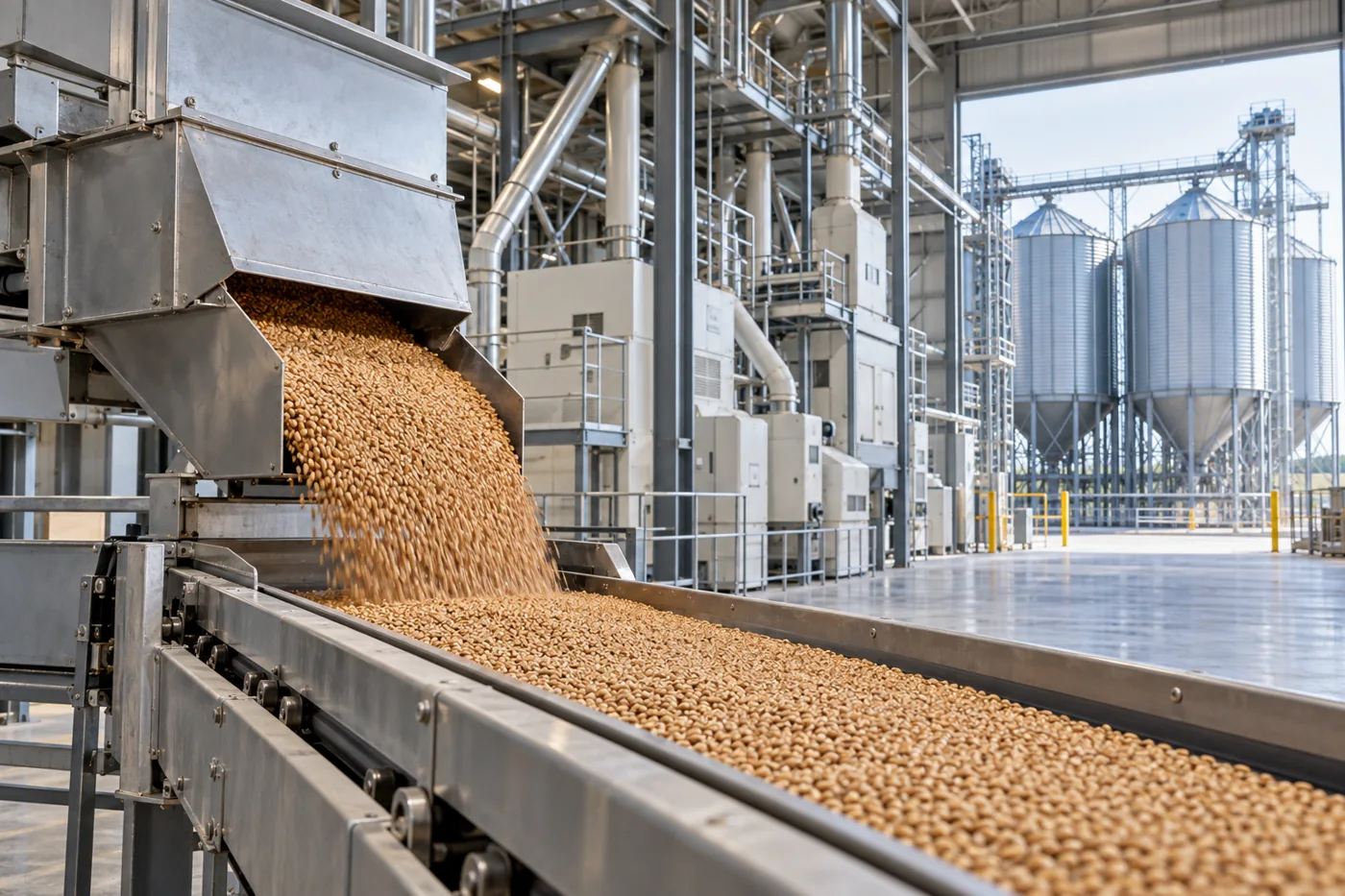
As fertilizer falls between belts, chutes and hoppers, it entrains and displaces air. Emissions increase with large drop heights, open gaps and materials containing more fines. During loading and bagging, displaced air can carry dust directly into the operator's work area.
Demand at these points is intermittent. The design must establish which operate simultaneously and which receive product peaks. Adding nominal capacities without considering actual use may oversize the assembly; assuming too little simultaneous operation can leave sources uncontrolled.
Characteristics that guide engineering
The design must reconcile ease of access, dust adhesion and corrosion. Returning fines to production depends on compatibility between formulations and the plant's quality criteria.
Solution configuration and sizing
Enclosures must contain the plume and allow aspiration to operate with less wind interference. The design must preserve inspection, belt replacement and access to gates so that operators are not encouraged to remove the enclosures during operation. The extraction take-off position must avoid direct aspiration of saleable granules.
In centralized networks, branches must be balanced for the intended combinations of use. Materials and surfaces must be compatible with abrasion, moisture and corrosive agents. Hoppers, rotary valves and screw conveyors may form part of fines removal; their capacity and sealing must prevent air backflow and the creation of a new emission at discharge.
Design parameters
| Parameter | How to assess it | Engineering decision |
|---|---|---|
| Drop height and geometry | Observe emissions with product present | Reduce dispersion before aspiration |
| Simultaneous operation | Identify active points | Distribute airflow among branches |
| Discharge and return | Check sealing and composition | Control dust without mixing products |
- Map chutes and discharge points.
- Reduce unnecessary openings.
- Balance branches.
- Provide airtight discharge and inspection access. Compare product losses and cleaning conditions before and after the intervention.
Performance, diagnostics and maintenance
Assessment must follow the transfer point with product present, rather than merely measuring velocity at the opening without loading. Dust escaping during belt startup, bulk-bag changeover or final filling indicates conditions that an average airflow may conceal.
In the collector, differential pressure and discharge help monitor continuity, while branch observation identifies deposition. Returning fines depends on formulation and quality criteria. Mixing dusts from different products in a collector can turn intended recovery into material with no productive use.
Inspection at transfer points
Monitoring during loading and bagging helps detect escapes that do not appear when the line is empty. Seals, closure of access points and branch adjustments must be checked after changes in product or capacity.
Further technical reading
Does your process need an assessment?
Talk to Kleema engineering about sizing, modernization and operating conditions.
Talk to engineering ↗