Cement
Process filters in cement production: kiln and grinding circuits
Filters connected to the kiln, raw mill and cement mill operate in circuits with distinct functions and conditions. The design must support both collection and the stability of the associated operation.
The process and emission sources
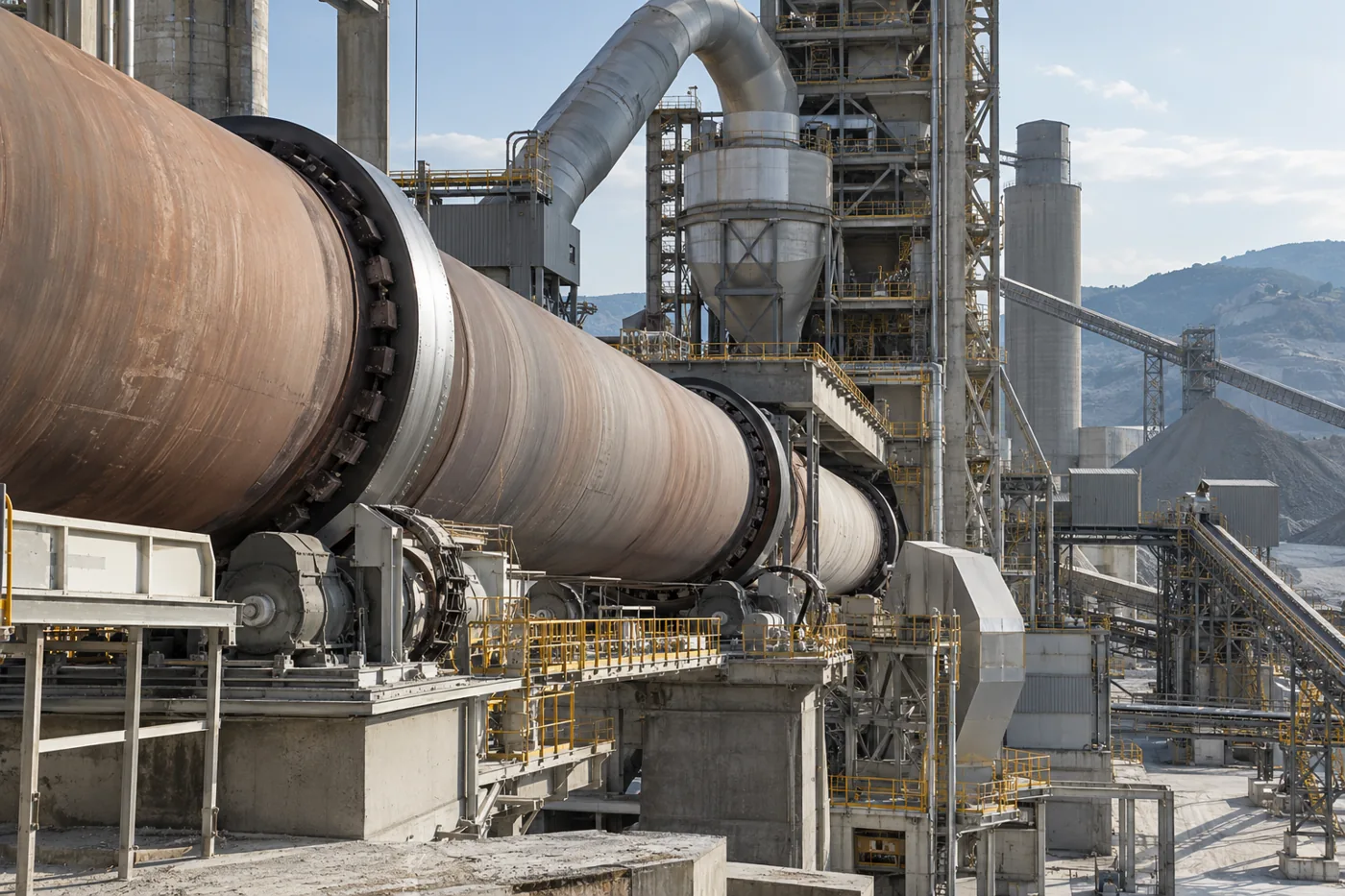
In the cement industry, filters connected to the kiln, raw mill and cement mill operate in distinct circuits. The kiln and raw grinding may involve thermal integration and changes between operating regimes; in cement grinding, ventilation, temperature and solids circulation serve different process needs.
Collected product may return to the circuit, but its destination depends on the collection point and composition. A process system must maintain production conditions and emission control simultaneously, without treating the filter as an independent accessory.
Characteristics that guide engineering
Temperature, moisture, composition and recirculation vary between application points. Gas distribution, filtration area and discharge must be compatible with these differences and production regimes.
Solution configuration and sizing
The survey must distinguish each operating mode, with flow rate, temperature, moisture and dust loading stated at filter conditions. Transitions between modes can alter condensation risk and loading on the bags. Fabric selection must consider this combination rather than only the highest stated nominal temperature.
Filtration area, gas distribution and internal velocities determine equipment utilization. Cleaning must restore capacity without indiscriminately removing the dust layer, while discharge must keep pace with collection and preserve tightness. The fan curve and controls must be compatible with the expected resistance range.
Design parameters
| Parameter | How to assess it | Engineering decision |
|---|---|---|
| Operating mode | Distinguish kiln and grinding conditions | Define the design envelope |
| Flow rate and moisture | Refer to filter conditions | Select area and filter medium |
| Solids return | Check composition and capacity | Integrate collection and process |
- Establish airflow balances.
- Check startup and shutdown conditions.
- Select filter media by application.
- Integrate ventilation and control. Emission targets must be verified under the conditions specified for the installation.
Performance, diagnostics and maintenance
Assessment must relate differential pressure, flow rate, temperature and production, distinguishing each circuit mode. An adjustment that is satisfactory with the mill running may not suit direct kiln operation. Analysis must also check false air ingress, damper operation and discharge condition.
Environmental performance must be verified under the conditions specified for the installation. Low emissions and circuit stability are complementary objectives: the collector may retain particles well yet still limit production through pressure drop or insufficient discharge. Integrated diagnosis helps direct adaptation.
Interdependence with production
Filter condition must be interpreted alongside the parameters of the kiln or mill it serves. Variations in pressure drop and flow rate may reflect process changes, and interventions must consider their causes to preserve stability.
Further technical reading
Does your process need an assessment?
Talk to Kleema engineering about sizing, modernization and operating conditions.
Talk to engineering ↗