Steel industry
Filtration in environments with slag and heavy particulate matter
Slag and hot-material handling areas expose extraction systems to abrasion and high-energy particles. The solution starts with emission control and identification of regions subject to impact.
The process and emission sources
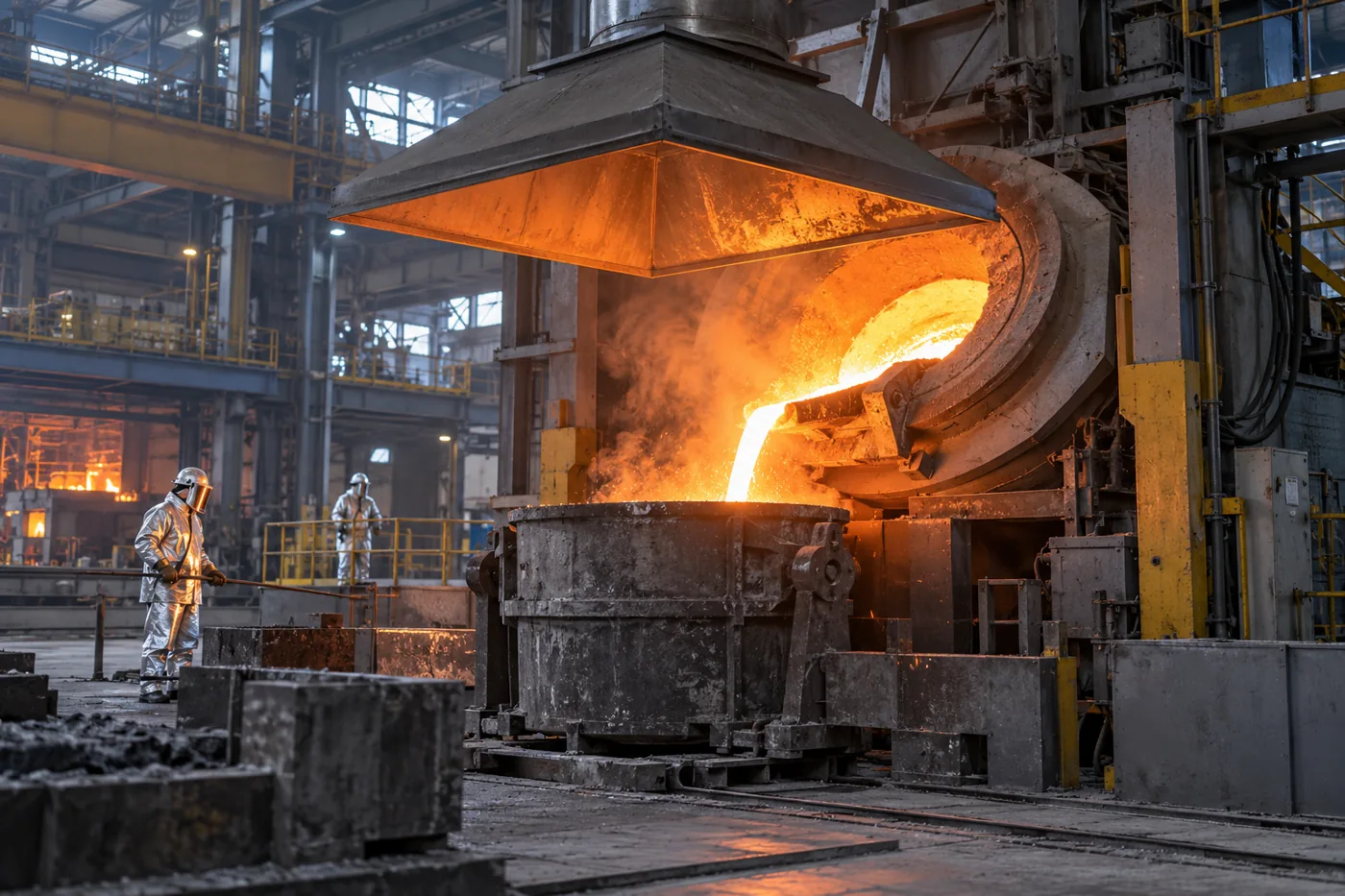
In areas with slag and heavy particulate matter, sources may involve dropping, crushing, cooling or conveying material with wide variations in size and temperature. Some may be coarse and have higher impact energy, while fines disperse more easily into the surroundings. Capturing both indiscriminately can increase loading on the circuit.
The design must separate emission control from product handling. The extraction pickup must act on contaminated air, avoiding turning the duct into a conveyor for fragments it was not designed to carry.
Characteristics that guide engineering
Reinforcing every plate can increase cost and weight without addressing the cause. Localized protection, inlet geometries and pre-separation may be assessed according to particle size distribution, temperature and available space.
Solution configuration and sizing
Enclosures and hoods must be compatible with access and the material trajectory. Pre-separation can reduce the entry of larger particles, and localized protection can extend the life of impact regions. The choice depends on particle size distribution, temperature and available space.
Casings and ducts must provide inspection access and wear parts where loads are concentrated. Lining the entire installation without identifying critical points can increase cost without resolving the dominant mechanism. The filter must receive a stream conditioned for its filter medium, while discharge must prevent heavy material from being retained in hoppers and removal devices.
Design parameters
| Parameter | How to assess it | Engineering decision |
|---|---|---|
| Size and temperature | Characterize material fractions | Define capture and pre-separation |
| Impact regions | Map thickness losses | Locate wear protection |
| Hopper discharge | Check continuity | Prevent retention of heavy solids |
- Determine the material profile.
- Provide inspectable linings.
- Size the discharge.
- Assess thermal risks and ignition sources. Maintenance must monitor thickness, sealing and hopper operation.
Performance, diagnostics and maintenance
Performance analysis must combine source emissions, thickness loss and continuity of discharge. Increased wear after a change in raw material or capacity may require a review of velocity or geometry rather than simply thicker plates.
Maintenance must identify regions with direct impact and distinguish them from corrosion or thermal damage. Repeated inspections at the same points help estimate the rate of degradation. Where hot material is present, intervention conditions must be defined consistently with the process and equipment limits.
Wear parts and availability
Access to protection components and parts subject to greatest wear influences shutdown duration. Defining replaceable parts and inspection points makes it possible to plan interventions without relying on rebuilding large equipment regions.
Further technical reading
Does your process need an assessment?
Talk to Kleema engineering about sizing, modernization and operating conditions.
Talk to engineering ↗