Steel industry
Steelmaking extraction: fume capture and gas management
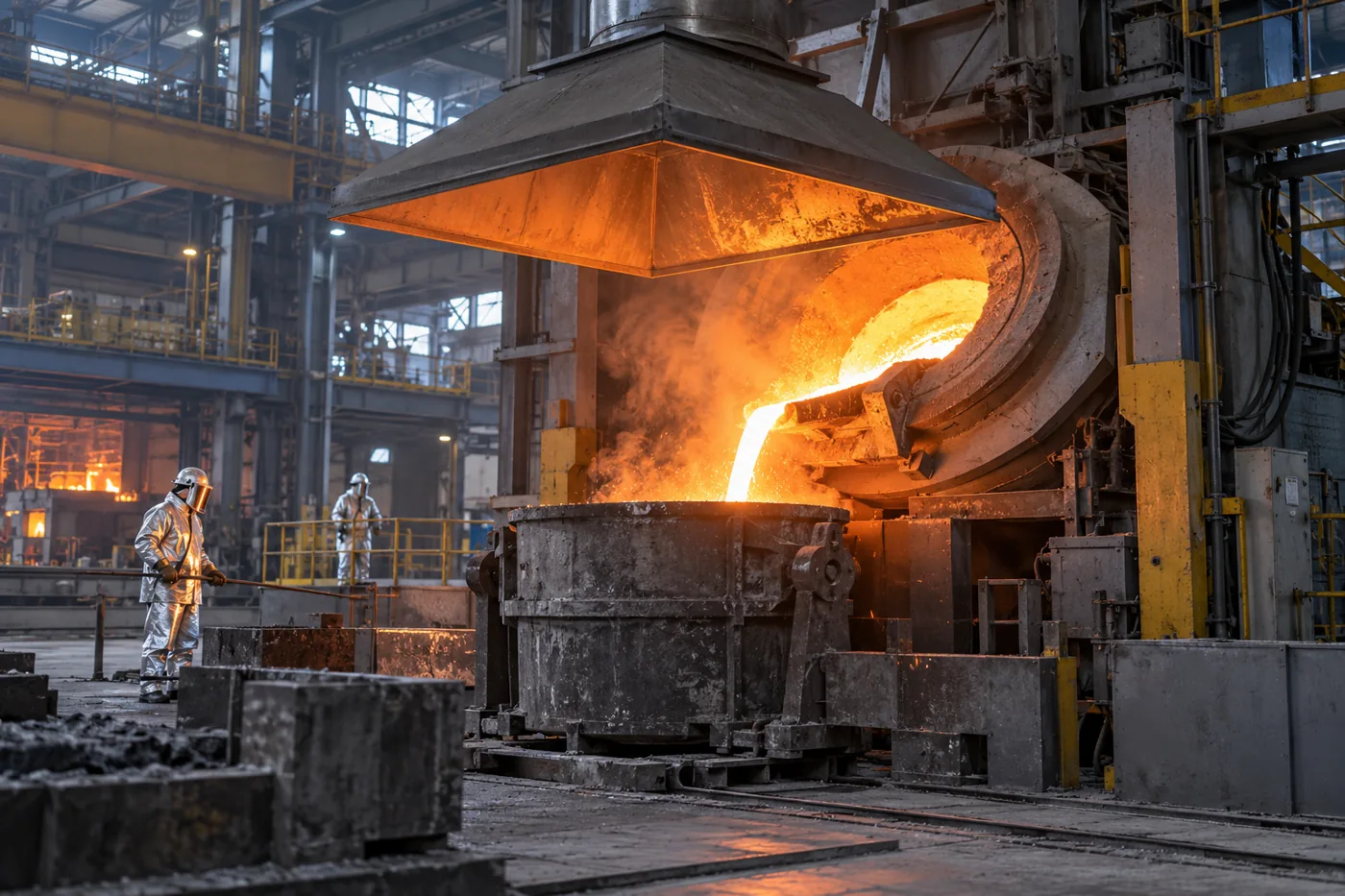
Melting and other steelmaking operations generate metal fumes, heat and gas streams of variable composition. Capture must follow the movement of sources and process cycles, preventing dispersion into work areas.
The process and emission sources
In steelmaking, emissions are not generated at a constant rate. Charging, melting, refining and tapping can change the position, intensity and direction of the plume. Strong thermal currents carry fumes toward high areas, while building openings and cross ventilation can displace emissions before they reach the hood.
Composition depends on the furnace, metallic charge and operations performed. Condensation fumes generally require a different approach from coarse particles entrained mechanically. For each source, primary process capture must be distinguished from secondary capture that reduces dispersion within the building.
Characteristics that guide engineering
Bag filters collect particles; they do not remove carbon monoxide through mechanical filtration. The presence of CO requires a specific assessment of extraction, monitoring and, where applicable, gas treatment or routing. Air renewal does not replace this analysis.
Solution configuration and sizing
Hoods and capture devices must be defined by the plume trajectory and the constraints imposed by load handling and overhead cranes. A collector with a large filtration area does not compensate for a poorly positioned hood. The design must also ensure sufficient make-up air in the building, preventing negative pressure from impairing the intended capture.
Downstream, thermal conditioning, distribution within the filter and solids discharge must be compatible with steelmaking cycles. Fan position, duct tightness and branch operating logic affect the available airflow. Streams containing CO or other hazardous gases require a strategy of their own; moving a contaminant through extraction does not amount to destroying it.
Design parameters
| Parameter | How to assess it | Engineering decision |
|---|---|---|
| Furnace cycle | Record operations and peaks | Match demand to fume generation |
| Airflow at each capture point | Measure across operating combinations | Check primary and secondary capture |
| Temperature and composition | Characterize streams separately | Define conditioning and additional treatment |
- Define primary and secondary capture.
- Account for thermal peaks and false air ingress.
- Select compatible filter materials.
- Relate airflow and pressure measurements to production cycles.
Performance, diagnostics and maintenance
Acceptance must cover different stages of the cycle and representative charge conditions. It is necessary to verify that peak emissions remain within the capture zone, branches receive the specified airflow and the filter recovers after the stages with the highest dust generation.
Outlet particle concentration, air conditions in work areas and the presence of gases are complementary checks. A single result does not substantiate all of them. If capture is poor while the filter is in good condition, the investigation must extend to hoods, interference and balancing rather than being limited to bag replacement.
Assessment throughout steelmaking cycles
Verification must follow the stages with the highest emissions and equipment movements, rather than relying on a measurement with the source stopped. Visible fumes, system measurements and occupational assessment provide complementary information on performance.
Further technical reading
Does your process need an assessment?
Talk to Kleema engineering about sizing, modernization and operating conditions.
Talk to engineering ↗