Pharmaceuticals and laboratories
Filtration in pharmaceutical processes: selection by application
Blending, transferring and handling pharmaceutical powders may require local capture and dedicated filtration. The solution must consider the product, hygiene requirements and cross-contamination risk.
The process and emission sources
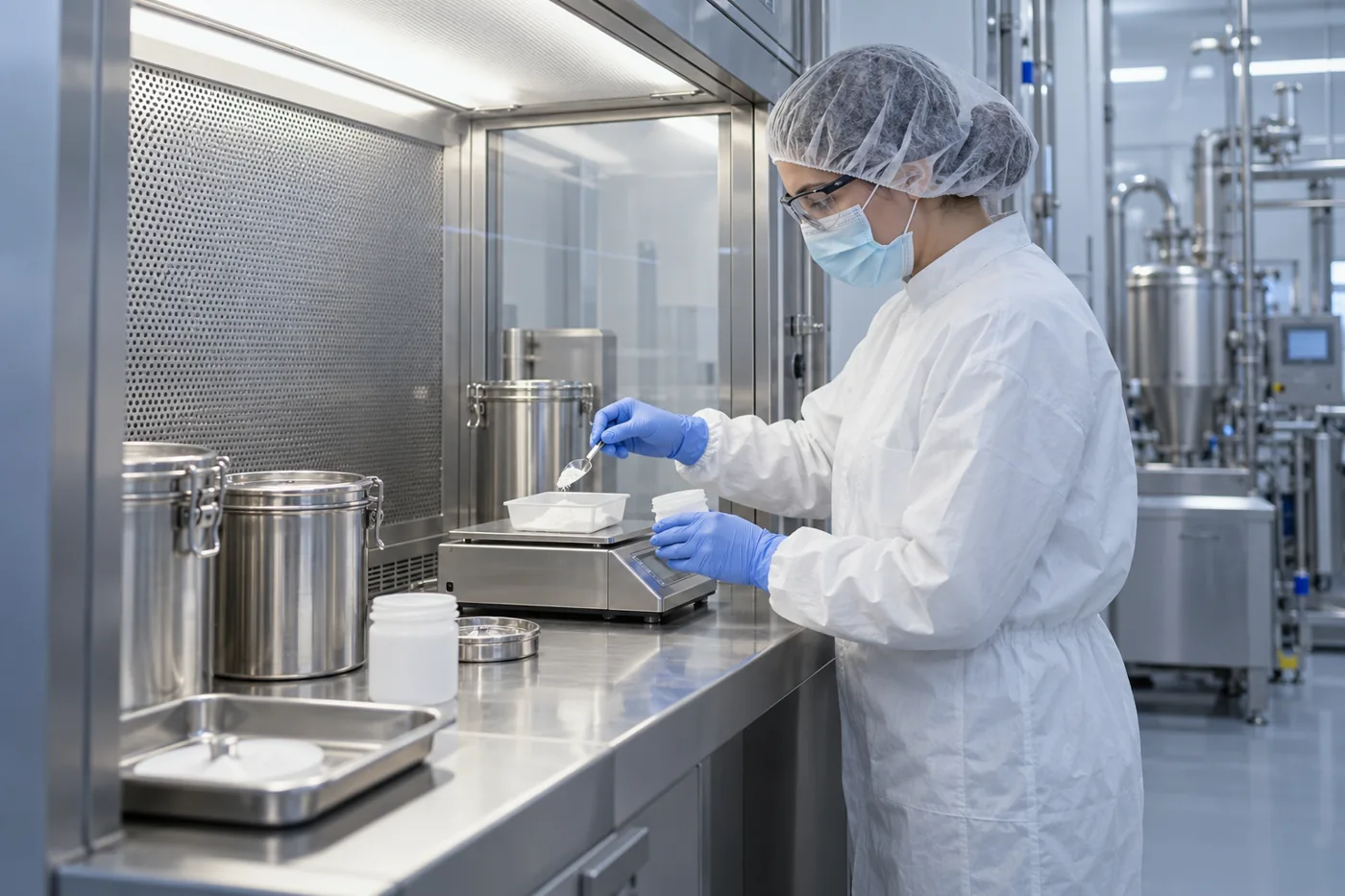
In pharmaceutical processes, blending, transfer and handling release dust at points with different hygiene and containment requirements. The system must identify the product, quantity and form of emission, as well as how the line will be cleaned between campaigns. Flow rate alone does not express the significance of the risk.
It is also necessary to distinguish dust collection from clean-area classification. Process extraction equipment may contribute to source control, but does not demonstrate that the room meets air-quality requirements or that exposure has been controlled in every task.
Characteristics that guide engineering
Compact cartridge filters may suit low-airflow indoor applications, provided they are selected for the dust and required containment level. Process suitability must be demonstrated without assuming compliance solely from the equipment type.
Solution configuration and sizing
Compact cartridge filters are an alternative for certain low-airflow indoor applications. Pleat area and shape must be compatible with material adhesion and cleaning. Bags or multistage configurations may be assessed where conditions call for different collection and maintenance behavior.
Materials, seals and access must be defined by the product and cleaning procedures. If high-efficiency final filtration or contained changeout is needed, these functions must be specified and verified separately. The discharge system must prevent solids removal from exposing the surroundings again.
Design parameters
| Parameter | How to assess it | Engineering decision |
|---|---|---|
| Product and campaign | Identify emissions and cleaning | Define application requirements |
| Element geometry | Assess dust and cleaning capacity | Select bags or cartridges |
| Containment and integrity | Define separate checks | Distinguish system functions |
- Define the operation served.
- Assess cleaning and contact materials.
- Provide for element changeout and disposal.
- Establish verification criteria and integration with the pharmaceutical installation.
Performance, diagnostics and maintenance
Verification must cover source capture, element condition and maintenance procedures. Differential pressure indicates flow resistance, but alone does not establish integrity or absence of cross-contamination. Qualification and exposure criteria must be defined with the pharmaceutical facility.
The solution must be reassessed when the product, campaign or operation changes. A collector serving a less critical powder should not automatically be transferred to a more potent active ingredient. Selection must demonstrate suitability for the application, with clearly defined limits and responsibilities.
Maintenance and verification
The configuration must allow maintenance without dispersing collected material. Changeout and cleaning procedures, element integrity and capture performance must form part of the checks established for the application.
Further technical reading
Does your process need an assessment?
Talk to Kleema engineering about sizing, modernization and operating conditions.
Talk to engineering ↗